
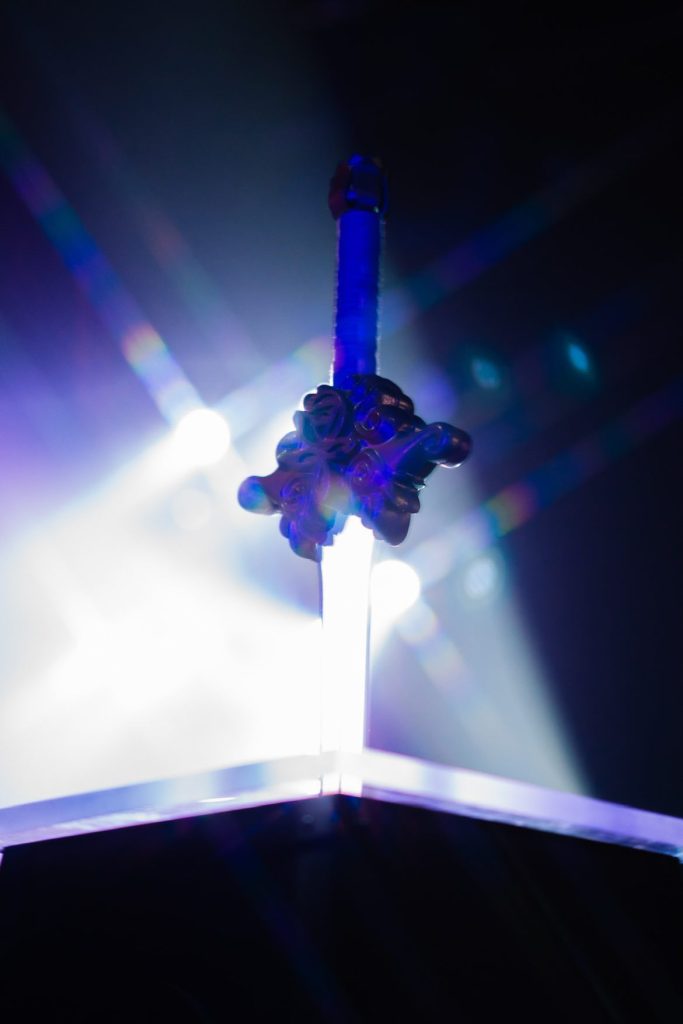


Magic Sword is an ageless tale of good and evil told through an ever expanding graphic novel with each volume accompanied by an original, synth-heavy soundtrack as well as immersive live performances. With the three mediums intertwined from conception, together they create an epic experience for those bold enough to bear witness and come away with a deeper understanding of the ultimate hero’s journey. Armed with a musical and visual aesthetic that has its roots unabashedly buried deep in the golden era of ‘70s and ‘80s fantasy and sci-fi, Magic Sword’s followers are called to another plane of existence where the struggle between light and shadow becomes all too real. The multiverse has aligned to bring the people of the land together for the birth of their album Endless, followed by a tour of the realm searching for the greater good.
The Immortals are:
The Keeper of the Magic Sword – red, keyboards
The Seer of All Truths – blue, guitar
The Weaver of all Hearts and Souls – yellow, drums
The Immortals give a direct account of their vision:
“In the beginning there was light… and darkness. A creation of perfect balance. As time passed, evil spread over the land like a plague, slowly consuming everything in its path. In the final moments before light was lost to the shadow for all time, a weapon of infinite power was created, the Magic Sword. Thus, restoring balance to the universe.
The genesis of things are often small. As the single seed grows to a mighty oak, so too did the path of the Keeper begin as a single choice in an age long past. Once a humble king, they were manipulated into unknowingly unleashing the Dark One. All of reality was torn asunder as the Lord of Shadow was released from their ancient prison, having been bound only by the power contained within the Magic Sword. From that day forth, the King was cursed to be the immortal Keeper of this powerful key. He has been relentlessly compelled for millennia to find the Chosen One who will one day unleash the true power of the weapon and cannot rest until the grand design is seen complete with the Darkness bound once again.
Little is known of The Lord of Shadow but death and decay. Since the release from his ancient prison by the hapless Keeper of the Magic Sword, he has pulled all of existence slowly toward himself in a vortex of darkness and destruction. Any wayward soul that he touches is corrupted to their ultimate demise. He uses his followers, acolytes of death, with no more regard than any other, for his reason of being is simply to end all things. Ensuingly, the forces of good have been searching for the Light to push him back into his eternal prison. The key to operate this cell is the Magic Sword; when wielded by the Chosen One, it has the power to return balance to the Universe.
The Keeper of the Magic Sword searches endlessly for the Chosen One. With the help of the other Immortals, The Seer of All Things and The Weaver of Hearts and Minds, they are ever trying to stem the tide of the Great Shadow from engulfing all life. Through time and space itself, The Immortals are pulled by the power of the Magic Sword to those who hunger for true justice. Whenever the need is great, they appear with the Magic Sword and a high stakes proposition for those who are pure of heart, perpetually hoping that their search is finally over.
This prophesied being contains the ability to wield the power of the Magic Sword and seal the prison that holds Dark One for all eternity. Only then will The Keeper, The Seer, and The Weaver be able to rest. Until the chosen one is revealed, the search continues in this realm and many others throughout all of time and space. In what form will the Magic Sword manifest? Who is the Chosen One? Will it be you? Answers will reveal themselves as the need arises. A tale of high adventure as old as time itself.”
Discography and corresponding novels:
Volume 1: Magic Sword (LP)
Volume 2, Chapter 1: Legend (EP)
Volume 2, Chapter 2: Awakening (EP)
Volume 2, Chapter 3: Endless (LP)
El Ten Eleven
We like to believe our lives can be shaped into stories—clean arcs, legible meaning—but life refuses the outline. Instead, it moves bluntly and without apology, indifferent to our sense of order. Events pile up without resolution, momentum divorced from direction, motion confused for progress. Sometimes the only refuge left is the nowhere of our own minds.
El Ten Eleven’s Nowhere Faster, the duo’s 16th release, was forged within that unease. Across eight tracks, it considers not just nothingness but velocity—the strange urgency that propels us forward even when the destination remains unclear. We are committed to acceleration, convinced speed itself might save us. The 33-minute album slows just long enough to pose the harder questions: what are we running from, and what do we think we can outrun?
That tension appears even in the album’s artwork, once again created with longtime collaborator Rob Fleming. It depicts a classic liminal space: familiar, anonymous, quietly unsettling. A stained glass-colored building and a streetlamp blur at the edges, suggesting motion that feels less like escape than enclosure—the kind that traps rather than transports.
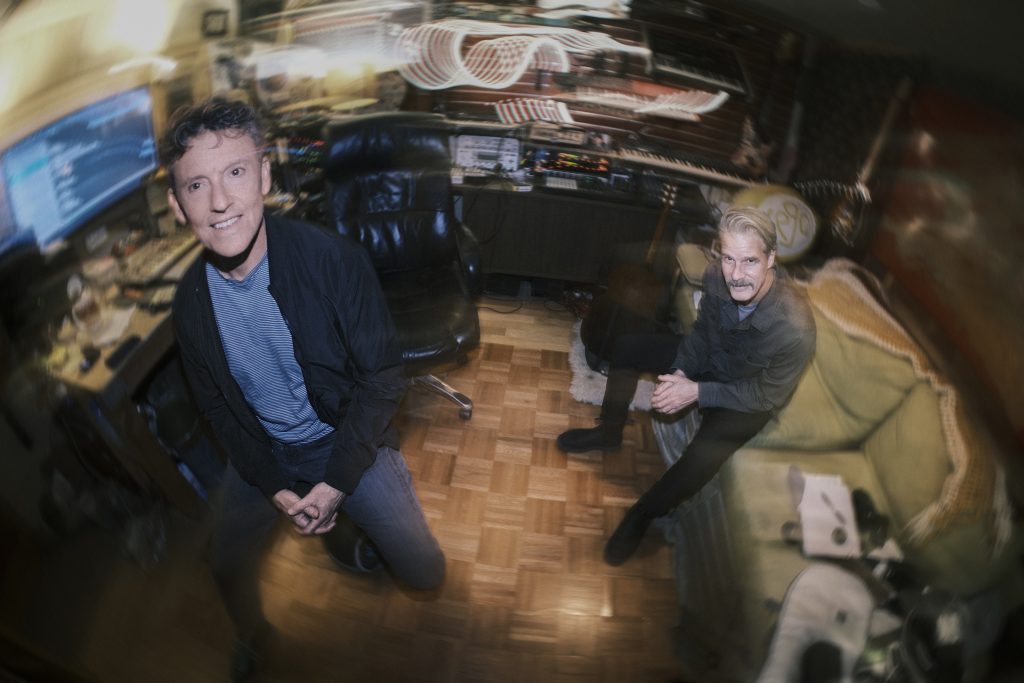
Nowhere Faster emerged from Kristian Dunn and Tim Fogarty’s longest break from touring and recording in their 23 years together, though “break” is something of a misnomer. Dunn’s famously restless creative pace never slowed. Instead, he began writing for not one but two drummers, handing Fogarty one of the most demanding challenges of his career. The record also marks a first for the band, weaving real strings and piano throughout, deepening the palette of what is already one of their most layered works.
The album’s titles and sounds draw from moments scattered across the band’s 23-year history. Opener “Uncanny Valley Girl” marks the return of long-retired effects like the delay pedal, stacking basslines into a dense, enveloping wall. It’s a clear-eyed take on AI-era paranoia, anchored by Fogarty’s steady rhythm—snare taut, cymbals gently alive—giving the sci-fi unease something solid to lean on. “Bjork’s Alarm Clock,” meanwhile, takes its title from an insult hurled at the band by a guitarist of a punk band on their first tour; you can almost hear Dunn and Fogarty’s quiet laughter beneath the buoyant bass and bow-scratched strings.
Still, Nowhere Faster is not a retreat into nostalgia. El Ten Eleven remains invested in risk and reinvention. The record continues to center Fogarty’s propulsive drumming and Dunn’s bass-driven experimentation: the first four tracks (“side A”) feature electric bass, while the latter half (“side B”) shifts to acoustic bass processed through pedals, subtly altering the album’s emotional weight. “Last Night In The Kitchen” reaches for the slick, sleazy bombast of classic Bond themes, opening new corridors for Dunn’s ever-expanding musical ambitions.
Album closer “So It Goes” draws inspiration from Dunn’s reading of Kurt Vonnegut’s Slaughterhouse-Five, coinciding with his reckoning with aging, loss, and the deaths of friends. Built around one of his stranger sonic experiments—a capo wrapped around a fretless acoustic bass—the song unfurls into a twangy, americana-inflected lament. It sounds like the quiet moments when reflection catches up to us, when we take inventory of the gnashes and scars left by the jaws of life.
Ultimately, Nowhere Faster is an album about reckoning—about time, endurance, and the uncertainty of how long a band, or a life, can last. We are all fumbling toward finitude. The question is not whether we’ll arrive, but what we want to hear on the way there. What will we dance to as the ground begins to shift beneath us? If nothing else, it may sound something like Nowhere Faster.
