
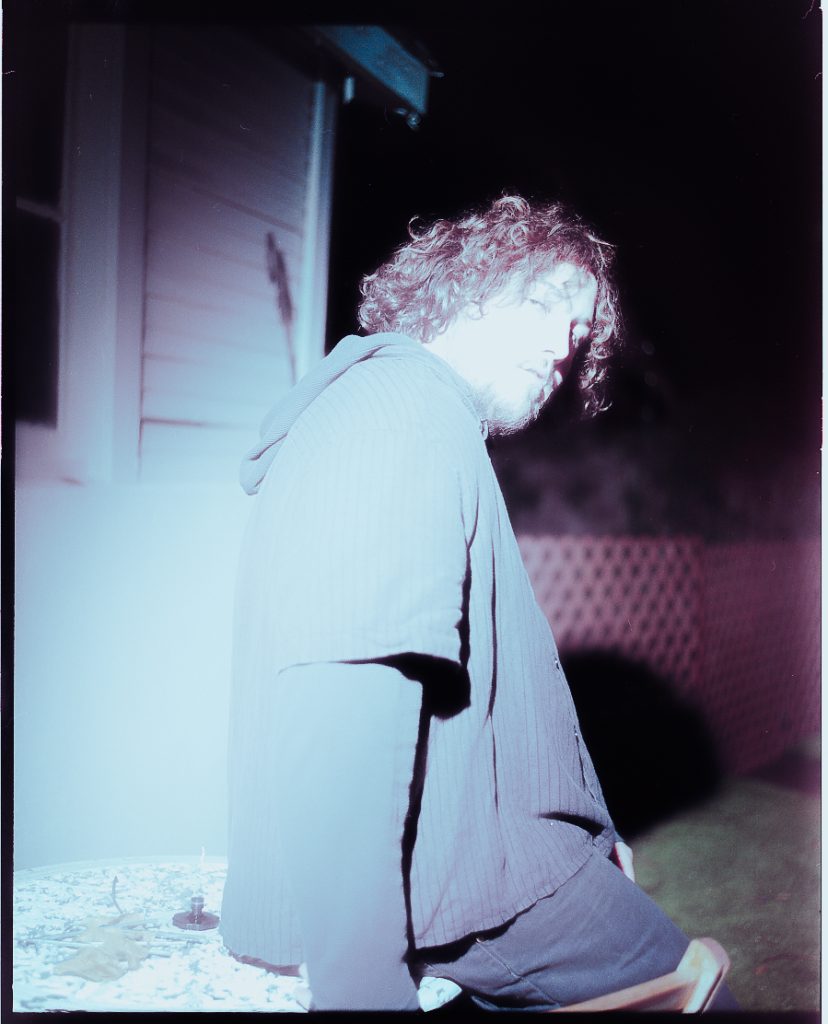


To make Base, Jack Rutter (who performs as Ritt Momney) had to let go of everything. He had to get to the point where he wanted to quit making music. Tear everything down and build it all up again. Rutter had to let go of all the shoulds, and all of the expectations he thought people had for him and his music. So he hit the reset button, forgot about all the noise, and made a record he truly wanted to make. It’s his most realized offering yet: beautiful and weird and cool. A record of lo-fi bedroom rock that radiates warmth and honesty.
Rutter’s story is one of reinventing yourself after viral success. After the release of his debut, Her and All My Friends, Rutter put out a cover of Corinne Bailey Rae’s “Put Your Records On.” The song was an unexpected hit, taking off almost half a year after it was initially released, and landing in the Billboard Hot 100. In 2021, he released his second full-length record Sunny Boy, a record of warm to the touch bedroom pop. And then Rutter started to fall out of love with music. “I was starting to feel like I was making music because I had to,” he says, “but then I realized, I didn’t have to make anything if I didn’t want to.” This release from expectations was like a lightning bolt: Rutter felt a kind of freedom he had not felt in years. Enter Base.
Base is Rutter’s third record. Since Sunny Boy, he’s bought a house in his native Salt Lake City, gotten married, and started treating his hobbies with the same seriousness he treats his music (for a period of time, he was bowling every morning of the week). In other words: he’s made a life for himself. A life where he has created the perfect environment to make music. Base is the product of this freedom. And you can tell from first listen. Base is a roomy, elegant collection of songs.
“I believe in base creativity,” says Rutter, “Some kind of pure being. A solid foundation.” This was the goal with Base: to make a record that is rooted in that sort of boundless creativity. To make it, Rutter joined up with his bandmates, Rick West and Chris Peranich. On his past two records, Rutter would write and produce everything. On Base, he wanted things to be more collaborative. He wanted the record to have more of a live, analog sound. Base was recorded on an 8-track. No screens allowed in the studio during the initial recording. They’d use computers a little bit after the fact, but the goal was to make something that sounded organic.
Like “Gunna,” a song about waiting and not knowing what you’re waiting for. The song starts out with acoustic guitars, then Rutter’s voice comes in. “As soon as she gets home,” he sings, “I’m going to be so nice.” There’s a little distortion, cracking open the song like you do with an egg and a fork. Keys and big drums. It’s a little Radiohead, a little Alex G.
Base is a record of intuitive music. For Rutter, that often meant writing what he knew best. Like “The Tank,” which is about the Utah Jazz. Rutter became obsessed with the Jazz’s pursuit of the best draft picks via racking up losses. “There is no pressure when you’re doing terrible,” he says, “But there’s this abstract idea that you could be amazing again in the future.” “The Tank,” is really about basketball. But it’s also about reinventing yourself, getting all the way back to your base and then rising out of the ashes. “Blow it up for Cooper,” sings Rutter in the song’s opening moments. There’s a melancholic quality to the song. But it’s also melancholic in a funny way. A lo-fi slacker anthem. That’s Base: a record about starting over and falling back in love with your art again.
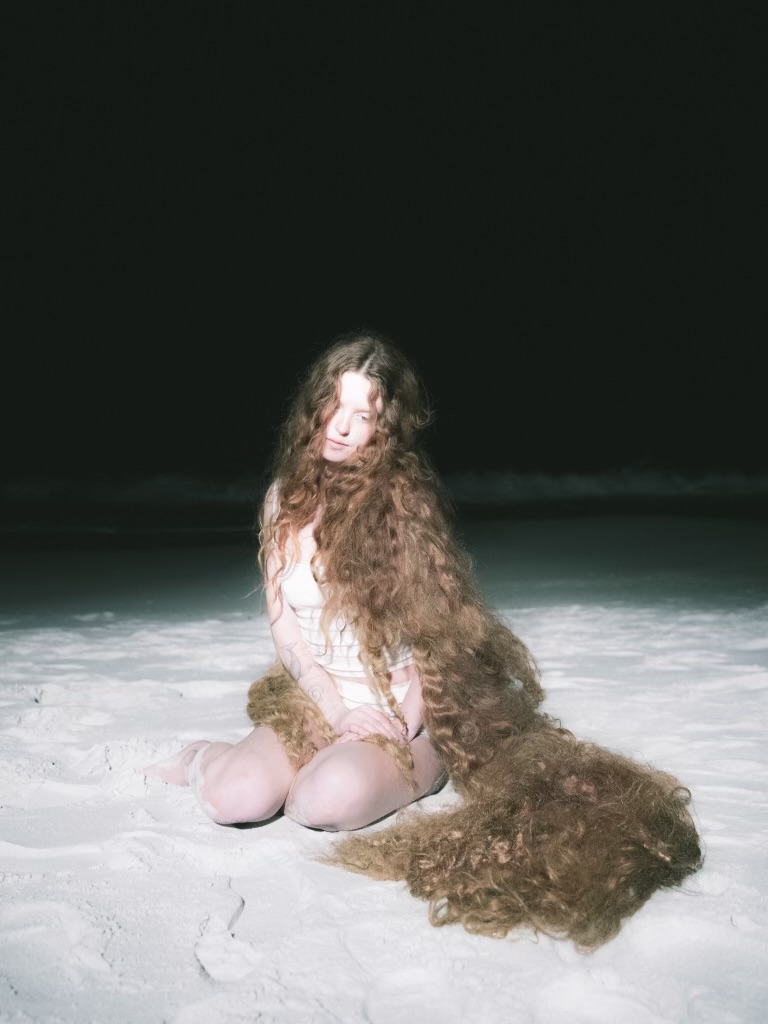
Mercury
For mercury – the project architected by Maddie Kerr – songwriting is a form of survival, a means of finding clarity in an often cruel world. Hailing from the rural outskirts of Franklin, Tennessee, music is everything she’s known dating back to the day 22 years ago when Mazzy Star’s “Fade Into You” blasted as she was born.
The artist’s latest three-track project comprised of “Born in Early May,” “Special,” and “Crick,” was born from another kind of place; an especially difficult period of personal hardship. Accompanied by a monumental short film directed by Harrison Shook and set to be unleashed in June 2024, this collection – titled “Together We Are One, You And I,” – wanders through the depths of human suffering and emerges resilient. Infinite black voids, spiritual iconography, and the scarlet glow of embers and flames define the three-part extended music-short film, which follows Kerr and a cast of characters from all different walks of life: Through narrative vignettes, contemporary dance, and poetic abstractions, these individuals are understood to be connected by grief, pain, and loss.
“Born in Early May” was a personal breakthrough for Kerr, the beginning of chipping through an emotional block. “It was the first time in a while I’ve allowed myself to put my emotions into words and to tell myself that it’s okay, I’m allowed to be hurt,” she says. Recorded in Asheville, North Carolina with Alex Farrar (Wednesday, Snail Mail, Indigo de Souza), this trio of songs pushes Kerr’s fiery rock songwriting toward cathartic new heights and “Born in Early May” sets the stage for what’s to come. A thrashing opening track, despairing images of ground-down teeth and a lecherous bird of prey are elevated by raw, pummeling guitar and Kerr’s riveting vocals.
The second song of the trio, “Special,” opens with a scene of surrender: “Removed my clothes/The color left my face/Lowered my body into the water.” Nature and elemental wonder are recurring motifs for Kerr, resonating deeply throughout the bones of mercury’s introductory singles “Woolgathering” and “Trying,” which debuted late last year. In “Special,” Kerr once again finds solace in underwater depths. “When I think about being in a dark place mentally, it feels like I’m suspended in the deepest part of the ocean with nothing around me.” In this peaceful purgatory, far from other people, Kerr nurses her wounds and admits a universal human desire atop sparse ambiance: “I wanna be something to you/I wanna be special too.”
If “Born in Early May” looks outward, “Crick” directs its gaze inward for the finale of “Together We Are One, You And I.” “When I was writing ‘Crick’ I was angry at myself for not being able to say what I meant in moments where I really needed to,” Kerr says. “I was angry at other people for not giving me the opportunity to speak for myself, but part of that was because I had waited too long to get my own words together.” Mounted with towers of guitars, the song hurtles toward a tremendously grungy conclusion that acts as a reminder: sometimes noise can convey an inner chaos beyond words.
It’s a sense of self-reflection, and subsequent relinquishing to the cascading waves of adversity that come into focus as we grow older. “Writing these songs has been part of a journey of figuring out my emotions and telling myself that it’s okay to feel that way, to talk about it, to write about it,” Kerr says.
Having made early noise with last year’s releases of “Trying” and “Woolgathering” – which seized the attention of Nylon, Paste Magazine, Under The Radar, Billboard and FLOODFM, while landing on numerous playlists across Spotify & Apple – the full force of Kerr is now ready to rear its head. mercury’s latest tracks are like hands reaching out through the darkness, offering companionship on your own journey through despair.
