
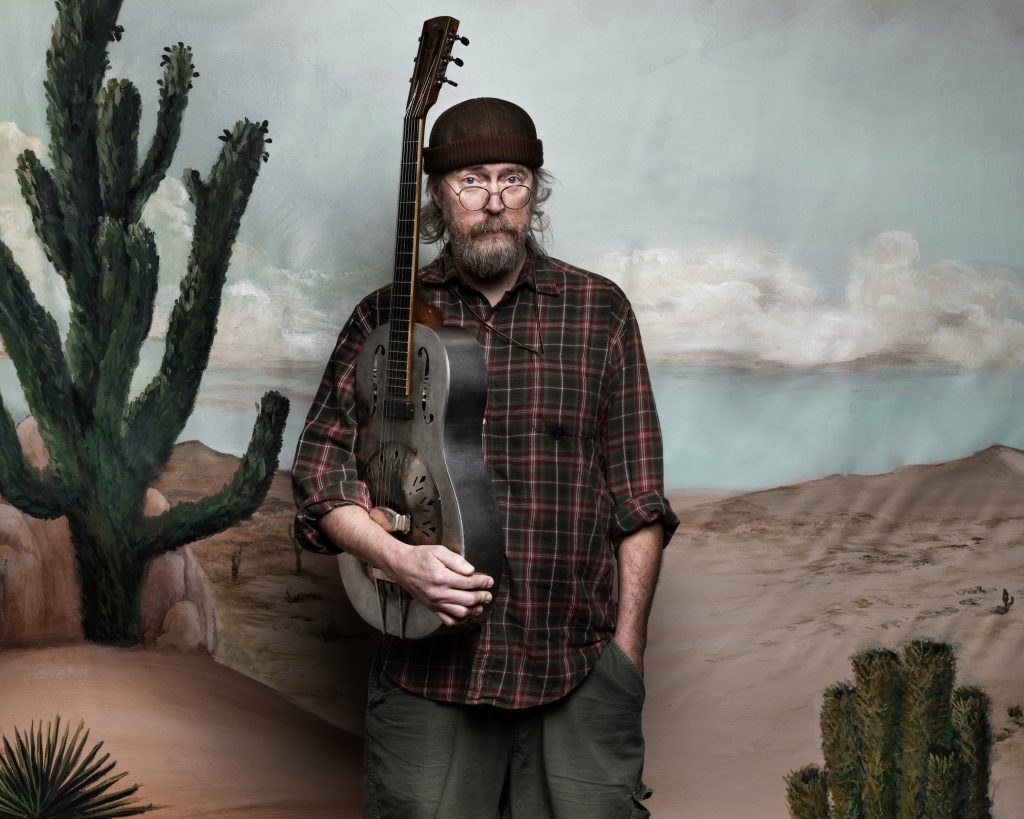


In the music of Charlie Parr, there is a sincere conviction and earnest drive to create. The Minnesota-born guitarist, songwriter, and interpreter of traditional music has released 19 albums over two decades and has been known to perform up to 275 shows a year. Parr is a folk troubadour in the truest sense: taking to the road between shows, writing and rewriting songs as he plays, fueled by a belief that music is eternal and cannot be claimed or adequately explained. The bluesman poet pulls closely from the sights and sounds around him, his lyrical craftsmanship built by his influences. The sounds from his working-class upbringing—including Folkways legends such as Lead Belly and Woody Guthrie—imbue Parr’s music with stylistic echoes of blues and folk icons of decades past. Parr sees himself merely as a continuer of a folk tradition: “I feel like I stand on a lot of big shoulders,” he said in an interview. “I hope that I’ve brought a little bit of myself to the music.”
With a discography simultaneously transcendental in nature and grounded in roots music, Charlie Parr is the humble master of the 21st century folk tradition. Parr started recording in Duluth in 2002, where he lives today. Life in the port town on Lake Superior has a way of bleeding into his work the same way his childhood in Austin, Minnesota does. Parr self-released his debut album, Criminals and Sinners, and did the same for his sophomore album 1922 (2002). With growing popularity abroad, Parr signed with Red House Records in 2015, where he recorded break-out albums Stumpjumper (2015) and Dog (2017). Parr’s music has an overwhelming sense of being present and mindful, and his sound is timeless.
Parr’s mastery of his craft is only more apparent when contextualized within the history of folk tradition of which Parr has dedicated his practice The land and lives around and intersecting with Parr have always influenced him, from the hills and valleys of Hollandale, Minnesota to the Depression-era stories from his father. Parr strives to listen to everything: “I don’t see that I’d ever be capable of creating anything if it weren’t for these inspirations and influences, books and music as well as the weather and random interactions with strangers and animals. So, the well never runs dry as long as my eyes and ears are open,” Parr said in a 2020 interview. Before he was even 10 years old Parr was rummaging through his father’s record collection—sometimes drawing dinosaurs on the vinyl sleeves—and listening to country, folk, and blues legends, many of whom are staples in the Folkways catalog. When Parr sings and plays his resonator or 12-string, you can hear influences like Mance Lipscomb, Charley Patton, Spinder John Koerner, Rev. Gary Davis, and Dock Boggs. This is especially true in his playing, when, after a diagnosis of focal dystonia, Parr turned to greats like Davis, Doc Watson, and Booker White for two-finger picking inspiration. Gifted a 1965 Gibson B-45 12-string by his father, Parr has never had a formal lesson and learned by to listening records and watching musicians he admired.
Parr’s first album with Smithsonian Folkways, Last of Better Days Head (2021), foregrounded his lyrical craftsmanship and sophisticated bluesman confidence, with spare production highlighting Parr’s mastery of guitar and elevating his poetry. Last of Better Days Ahead is a portrait of how Parr saw the world in that moment, reflecting on time and memories that have past while holding an enduring desire to be present. In his 2024 release, Little Sun, Parr weaves together stories celebrating music, community, and communing with nature. Putting forth an ambitious and raw album that exemplifies the best of Parr’s sound: a blend of the blues and folk traditions he continues to carry with him and the steadfast originality of a poet.
Travis Ward
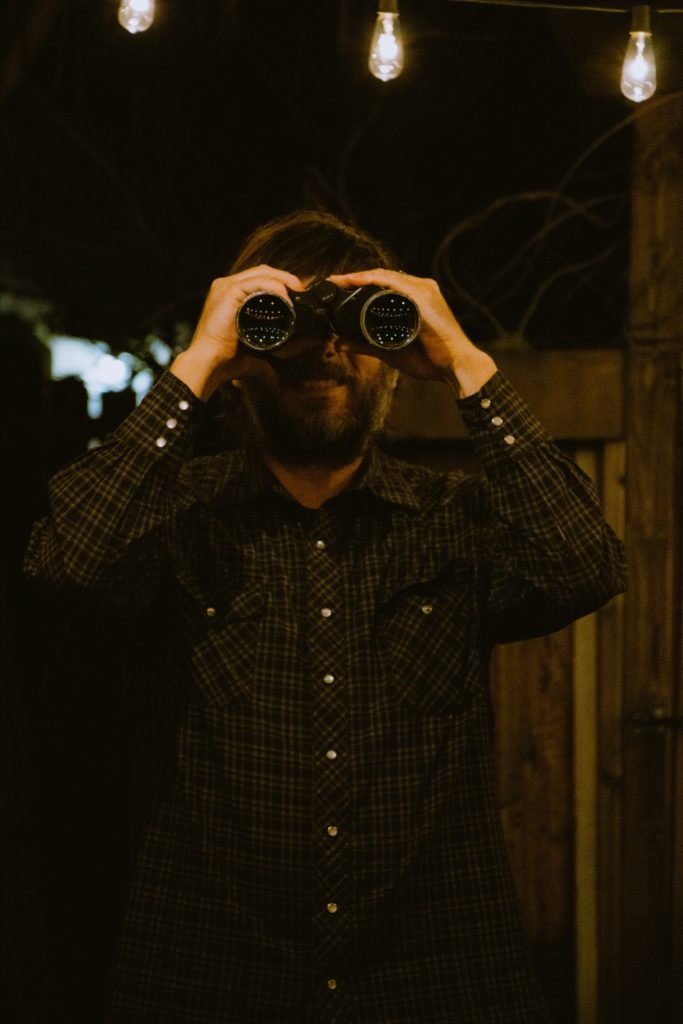
Travis is a bare-knuckled folk singer, a broke-down blues man, a DIY archivalist, producer, retired basketball player, fly fisher, poodle walker, but most importantly, a family man. Travis has toured the US, UK, and Europe. He’s played countless dive bars, festivals, and theaters from near and far, created film, soundtrack, and live theater work. He’s been busted, disgusted, and mistrusted, yet he continues to make meaning of the world through his favorite medium, the well-crafted and timeless song. Travis’s newest release, The Opener by Travis Ward, is a collection of stark, minimal recordings that paint a landscape of a folk singer’s journey.
Discography:
Hillfolk Noir – Skinny Mammy’s Revenge, 2010
Hillfolk Noir – Radio Hour, 2012
Travis Ward – Jump Up and Jolitties, 2012
Hillfolk Noir, What’s That Hat For? 2013
Hillfolk Noir – Pop Songs for Elk 2015
Hillfolk Noir – Junkerpunch, 2017
Hillfolk Noir – Pickles for the Apocalypse 2023 (Junkerdash Records)
Floating Witch’s Head – You Look Like a Rainbow, 2024 (Moon Ruins Records)
Hillfolk Noir – The Opener by Travis Ward, 2025 (Junkerdash Records)
Teach and Wrong – Podcast, Season 1 & 2, 2024 – current
The Opener by Travis Ward is the newest creation from Hillfolk Noir’s songwriter, Travis Ward. The record is a quasi-conceptual piece that runs adjacent to the life of a folk singer. Not exactly autobiographical, but not a far stretch either… The Opener consists of two tracks, Side A (11 songs) and Side B (10 songs). DIY or Die! All songs were written, recorded, and mastered, artwork created, graphically laid out, paid for, and promoted by Travis Ward, Hillfolk Noir, and Junkerdash Records. Folk art crafted by hand in Boise, Idaho, and created for all ears.
Tony Polecastro
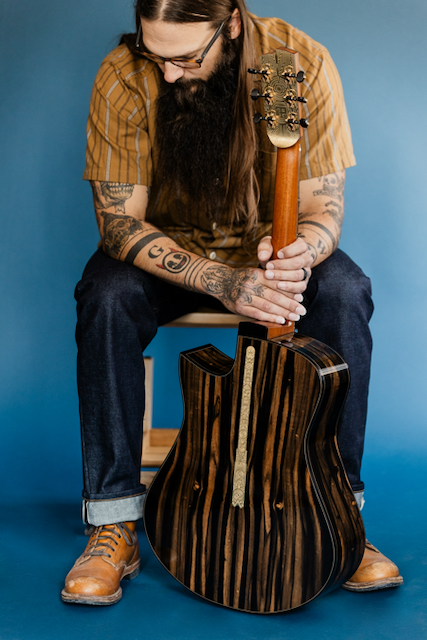
Fueled on pickled beets and cheese curds (the kind that squeak when you bite into them), Tonytraveled to Montana from Chicago in 2008 on a pawn shop riding lawn mower and never looked back. His work runs the gamut from introspective self-deprecating folk songs to sparse yet impactful instrumentals on guitar, banjo, and slide guitar. He often shares the stage with Livingston songwriter Shelly Besler Kersbergen, as well as a good helping of his guitar heroes from Charlie Parr to Tony Furtado. Solo performances from Tony are as rare as a Sasquatch water skiing, however said solo performances are known to exist… ironically he just so happens to be twice removed from the sasquatch family lineage.