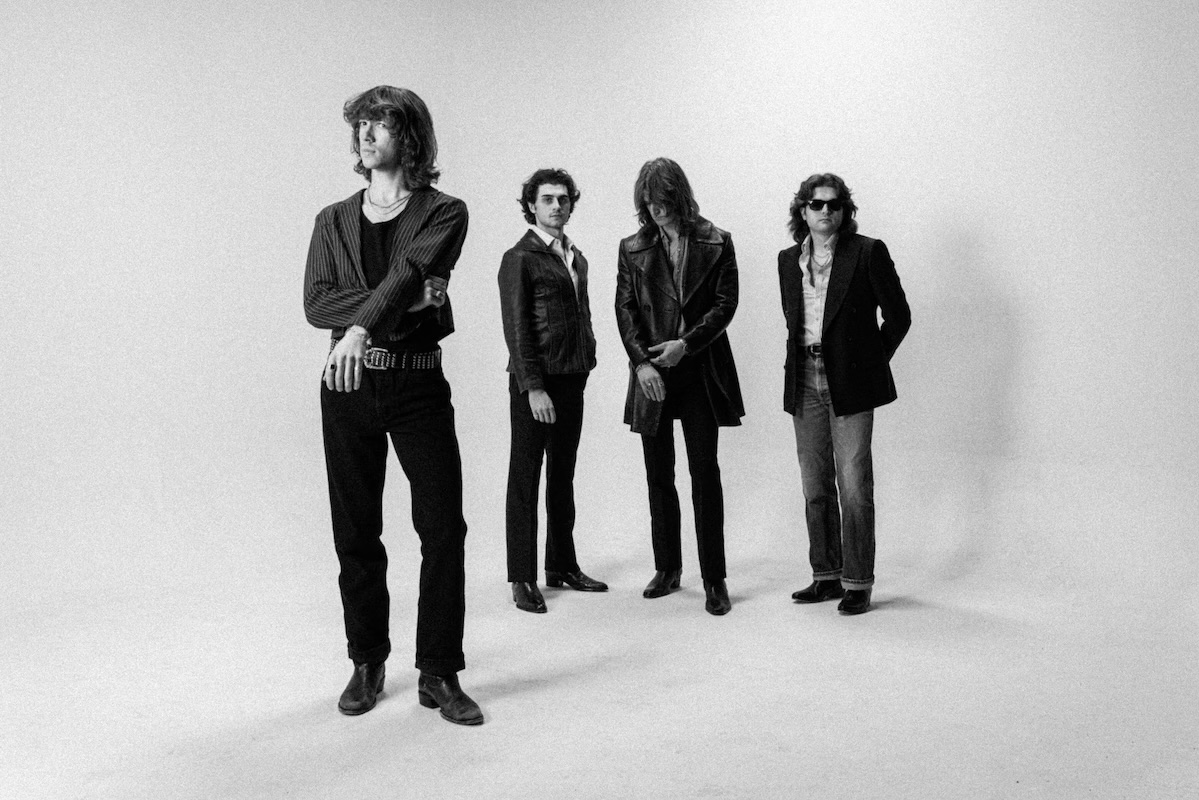
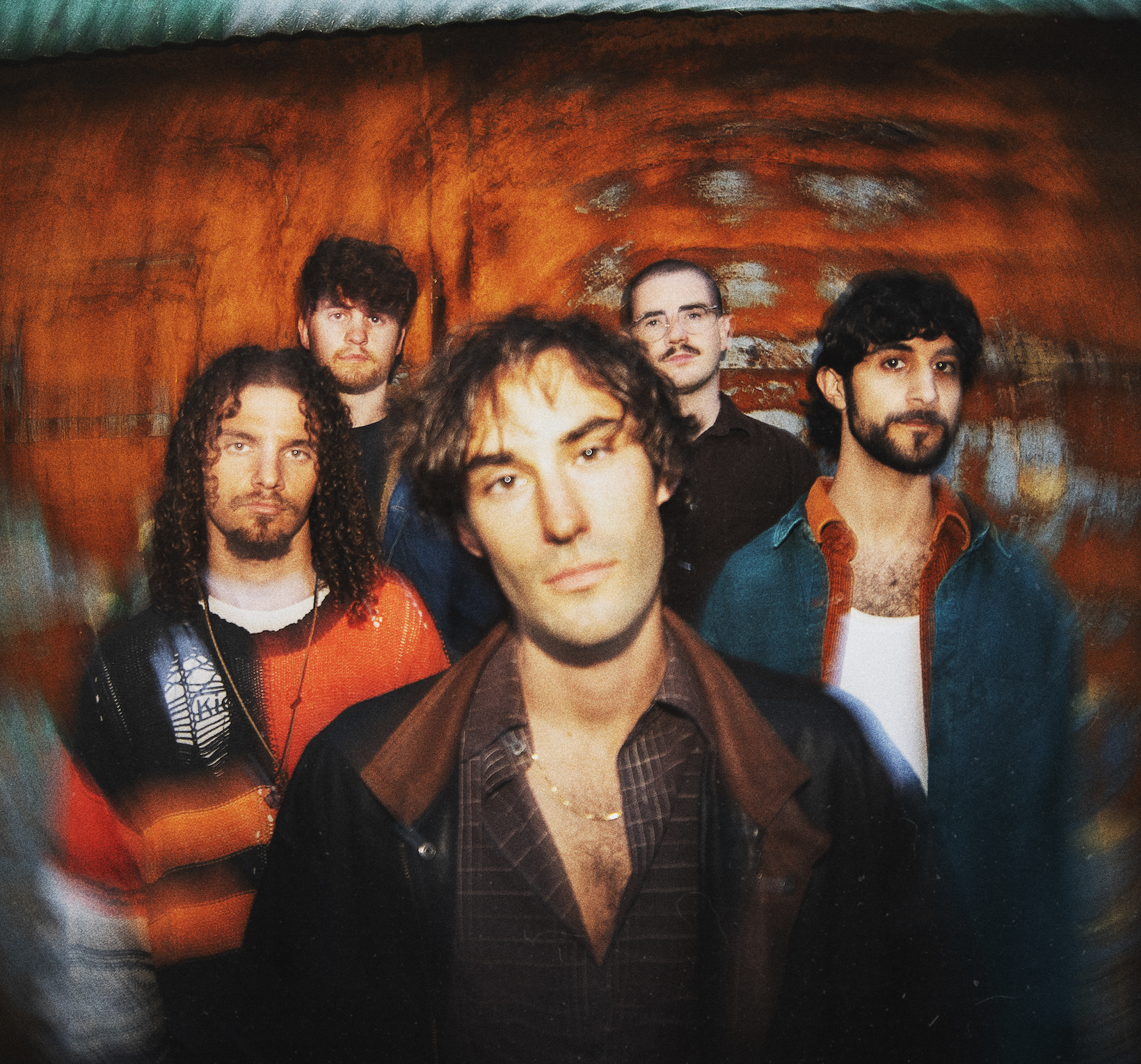
“What can we do to get people off their fucking phones?” exclaims founder and frontman Luke Faillaci, explaining the mission behind Fai Laci, the band he founded and fronts. “And how can we give them something real and make them have a great time? That’s the most important thing we can do: Just communicate with our followers and let them know they fucking rule!” The Boston quintet — which also includes guitarists Anthony Cervone and Michael “Goldie”
Goldblatt, bassist Cal Hamandi, and drummer Zack Putnam — have already amassed a grassroots fanbase thanks to their energetic, wildly cathartic live shows around the Northeast. They’ve seen a community coalesce around their inspired rock songs, with a quarter-million monthly followers and millions of streams despite, until recently, having no label, no publicist, and no manager.
They’re proof that good tunes can still find their audience, and they’re working hard to bring others into the fold. “We’ve always been making music for ourselves, and we’re going to hold ourselves to that, because we know other people will want to hear it, too.”
Fai Laci are a band with a mission, and Elephant in the Room is the ideal vehicle to achieve it. Produced by Dan Auerbach and recorded at his Easy Eye Sound Studios in Nashville, the album blends the urgency of punk and the stomp of glam with the theatricality of classic rock, all bound together by the band’s sharp swagger and Faillaci’s boundless charisma. Especially for a debut, it’s confident and surprisingly diverse, full of brazen rockers and bruised-heart ballads. The band expertly traverses the psychedelic time and tempo changes of “Cure Upon the Hill” with the
same grace and nuance that they bring to “Beautifully Boring,” a dreamily bittersweet anthem about navigating your young adulthood with your sense of self intact. In between, they deliver bangers like the decadent “Sarasota” and the jittery new wave “Headlights”, each a showcase for their inventive guitars and nimble rhythm section. “We never set out to make a certain kind of sound,” says Faillaci. “It takes us wherever it takes us. We got more into the rock side of things on the album, but we also wanted to have some really beautiful songs on it. We wanted to have something for everybody.”
That’s been the defining Fai Laci attitude since Faillaci founded the group. Working by himself and learning as he went along, he released two EPs and a handful of singles that he hoped might eventually make their way beyond his circle of friends. Those early songs reveal a young artist still integrating all of his favorite artists, from the obvious (Bowie, Nirvana, The Doors) to the not-so-obvious (The Highwaymen). “My dad played them around the house all the time, and I loved the songwriting and storytelling aspect of their songs. When I was a teenager, I went through an era of loving rap music, especially this artist Felly. I drew a lot of inspiration from him, and that’s when I realized I could just produce myself. I was just figuring out how to make sounds and record them...and I sucked! But I enjoyed it because I was learning how to make the music that I wanted to listen to.”
Gradually, Faillaci brought players into the band, based more on personality than chops. “It was never about adding another guitar just to have another guitar,” he says. “It was about getting the right people. I knew they’d be a good fit for the band because nobody has an ego. We’re all pretty level-headed.” Currently, all five band members live together in a house in Medford, Massachusetts, where they can jam ceaselessly and record whenever inspiration strikes.
“Everybody holds their own with production and songwriting. Everybody writes. Everybody gets a vote. So, there’s been a huge shift in our sound because everybody is bringing their own ideas to the music. I can’t imagine making this music with anybody else in the band.”
Soon their music made its way to Auerbach, one half of the Black Keys, whose first response was: Get ‘em in the studio. “I couldn’t believe it,” says Faillaci. “It was the craziest shock of my life. We didn’t know what we were getting into, because we’d never recorded as a full band before.” They made two trips down to Nashville, where they had a few co-writing sessions with Auerbach and Daniel Tashian (Kacey Musgraves, Demi Lovato) and holed up at Easy Eye Sound Studios. “It was a learning experience, and it gave us the confidence to try things a little differently. We did some
overdubs and tried some things to give the record a cool studio sound, but we were focused on making it sound like a performance, like a band playing together. We wanted to capture that feeling we get when we’re playing live.”
The five players had a breakthrough while they were working on the opener, “Cure Upon the Hill,” which opens with a Springsteen reference and a deep urge to break free: “Oh, my mamma told me I was born to run, shed off my dirty clothes and burn into the sun.” The song lives up to that sentiment, constantly twisting itself into new shapes as though nothing could hold it in place.
“We had basically finished the song, and when we got to the outro, we were trying to figure out what to do. We thought about a double chorus or something like that, but it seemed too easy, too predictable. We don’t want to take the easy route. We don’t want to be predictable. So, let’s do this huge tempo modulation into the choir outro with a dual guitar solo thing.” That decision makes a great song even better, introducing an album full of little sparks of inspiration that catch you off guard and make you put down your fucking phone.
“Have You Nothing Left to Say” opens with Cervone playing the national anthem on guitar, a nod to Jimi Hendrix at Woodstock, but also an acknowledgement of the sad state of the union. “That’s something Anthony started doing during our live shows, and then we’d talk about the bad shit going on in America right now and how it’s up to us to make things better. We had to include that on the album, because that’s such a crucial part of the message. Fai Laci aren’t an explicitly political band, but they do see rock and roll as a subversive force: a battering ram for storming the castle, the glue that binds people together into a community that’s more powerful than any one person. It is, ultimately, a noble pursuit. “We’re trying to get people together so they can hang out and just talk to each other,” Faillaci explains. “So, let’s be as real as possible. Let’s keep hammering away at the stuff that makes a true difference to the people in front of us. We’ve proved on a small scale that we can do that. Now it’s just a matter of finding cool ways to do it on a larger scale.”
UPCOMING SHOWS