


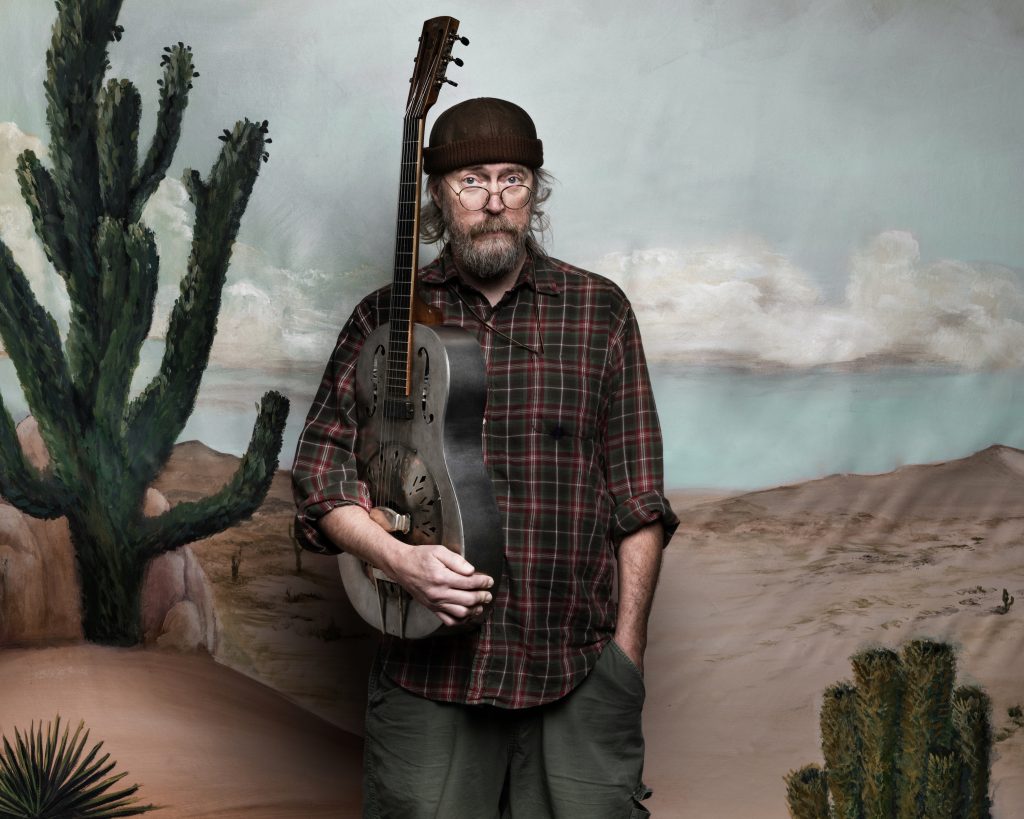


In the music of Charlie Parr, there is a sincere conviction and earnest drive to create. The Minnesota-born guitarist, songwriter, and interpreter of traditional music has released 19 albums over two decades and has been known to perform up to 275 shows a year. Parr is a folk troubadour in the truest sense: taking to the road between shows, writing and rewriting songs as he plays, fueled by a belief that music is eternal and cannot be claimed or adequately explained. The bluesman poet pulls closely from the sights and sounds around him, his lyrical craftsmanship built by his influences. The sounds from his working-class upbringing—including Folkways legends such as Lead Belly and Woody Guthrie—imbue Parr’s music with stylistic echoes of blues and folk icons of decades past. Parr sees himself merely as a continuer of a folk tradition: “I feel like I stand on a lot of big shoulders,” he said in an interview. “I hope that I’ve brought a little bit of myself to the music.”
With a discography simultaneously transcendental in nature and grounded in roots music, Charlie Parr is the humble master of the 21st century folk tradition. Parr started recording in Duluth in 2002, where he lives today. Life in the port town on Lake Superior has a way of bleeding into his work the same way his childhood in Austin, Minnesota does. Parr self-released his debut album, Criminals and Sinners, and did the same for his sophomore album 1922 (2002). With growing popularity abroad, Parr signed with Red House Records in 2015, where he recorded break-out albums Stumpjumper (2015) and Dog (2017). Parr’s music has an overwhelming sense of being present and mindful, and his sound is timeless.
Parr’s mastery of his craft is only more apparent when contextualized within the history of folk tradition of which Parr has dedicated his practice The land and lives around and intersecting with Parr have always influenced him, from the hills and valleys of Hollandale, Minnesota to the Depression-era stories from his father. Parr strives to listen to everything: “I don’t see that I’d ever be capable of creating anything if it weren’t for these inspirations and influences, books and music as well as the weather and random interactions with strangers and animals. So, the well never runs dry as long as my eyes and ears are open,” Parr said in a 2020 interview. Before he was even 10 years old Parr was rummaging through his father’s record collection—sometimes drawing dinosaurs on the vinyl sleeves—and listening to country, folk, and blues legends, many of whom are staples in the Folkways catalog. When Parr sings and plays his resonator or 12-string, you can hear influences like Mance Lipscomb, Charley Patton, Spinder John Koerner, Rev. Gary Davis, and Dock Boggs. This is especially true in his playing, when, after a diagnosis of focal dystonia, Parr turned to greats like Davis, Doc Watson, and Booker White for two-finger picking inspiration. Gifted a 1965 Gibson B-45 12-string by his father, Parr has never had a formal lesson and learned by to listening records and watching musicians he admired.
Parr’s first album with Smithsonian Folkways, Last of Better Days Head (2021), foregrounded his lyrical craftsmanship and sophisticated bluesman confidence, with spare production highlighting Parr’s mastery of guitar and elevating his poetry. Last of Better Days Ahead is a portrait of how Parr saw the world in that moment, reflecting on time and memories that have past while holding an enduring desire to be present. In his 2024 release, Little Sun, Parr weaves together stories celebrating music, community, and communing with nature. Putting forth an ambitious and raw album that exemplifies the best of Parr’s sound: a blend of the blues and folk traditions he continues to carry with him and the steadfast originality of a poet.

Two Runner
Amid the excitement and ambiguity of a new start, Paige Anderson of Two Runner poses poignant questions on Porchlight, her resolute and tenderhearted new record. Beautiful string arrangements, intimate confessionals, and rollicking hymns for the lost and determined, here is an artist who’s been on the road consistently since early childhood – with persistence and commitment to her craft clearly in no short supply.
Porchlight offers tunes that are warm and steady, relatable nostalgia twinged with the ache of needing to move on. The result aptly links the uncertainty of letting go and simultaneous resolve of someone faced with no other choice. A destiny perhaps sealed from an early age, as Anderson began her touring career in a six-person family bluegrass band from the age of nine. Now nearly a decade into her own music career, she’s seen stages warming up for Sierra Ferrell, Watchhouse and Molly Tuttle.
Although change often comes en masse, it is surreal and jarring to start again. Paige Anderson offers Two Runner as solace and escape for those needing to reset, with sage comfort and kindness from her own accounts, the way all great songwriters do. Porchlight is perhaps best summed up by the chorus in track five, ‘Mocking Crow’: “Wake up tomorrow, there’s no in between – your heart knows what you need.” A reckoning, a stark look in the mirror, hope, and forward movement against all odds.
