
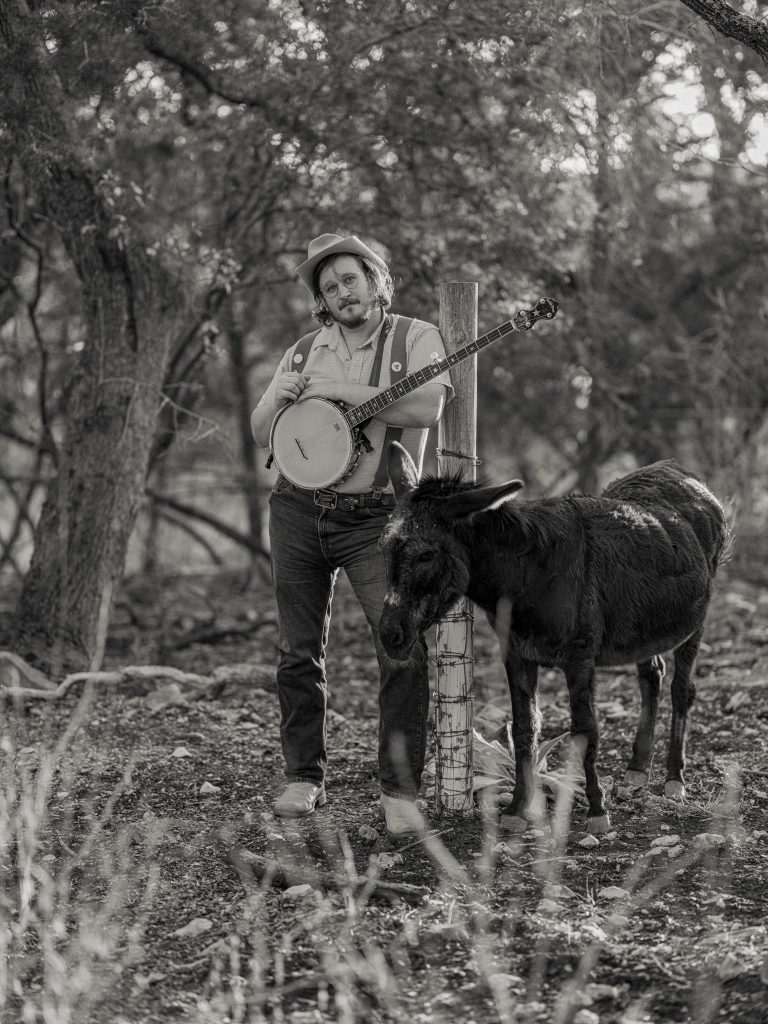


Folksinger Willi Carlisle holds tight the conviction that love is bigger than hate, and no-one is expendable. Carlisle’s music has always been a dance between absurdity, spectacle, and philosophy. On his fourth studio album, Winged Victory, Carlisle returns with his signature blend of traditionally-rooted folk music and kaleidoscope of oddball characters to confer with his core tenets in more overt and provocative ways.
“These songs feel poised on the edge of the apocalypse, or at least at the beginning of a great transformation in America,” Carlisle says. “During this borrowed time, the weirdos, cowboys, and dreamers in these songs dare to love, and often pay for it with blood.” Carlisle delivers Victory as the next chapter in his long-running direct address to the hope that by understanding our collective suffering, we might be free of it. He’s intent on creating art and a well-rounded life in a broken world. The idea began with 2022’s Peculiar, Missouri when Carlisle proclaimed “your heart’s a big tent, everybody gets in.” After gathering together all the world’s weirdos and misfits under the big tent, with 2024’s Critterland, Carlisle let them loose into the world. Now, on Winged Victory, they speak for themselves, unencumbered by social expectations.
Victory, Carlisle’s first self-produced album, will be released June 27 via Signature Sounds. It both indulges several of his wildest dreams and feels like the inevitable sequel to Critterland’s charismatic menagerie of chaos. Though occasionally raunchy, and routinely provocative, Victory is not afraid to make a spectacle for the sake of a point. Victory should be understood as a reflection. It revels in the beauty of tiny, monetarily-worthless moments and things, offering with them a consideration of our innate humanity. To set the stakes of the story, Carlisle opens with a cover of protest song “We Have Fed You All for 1000 Years.” Written by an unidentified Industrial Workers of the World member (IWW) for an early union strike, the song lays out one of the many ways the working class sustains the world.
“I can think of no better way to set the terms of any argument that I’m going to make than, ‘if, blood is the price of your cursed wealth/ by God, we’ve paid in full,’” Carlisle says, quoting the song. “I love that it’s a voice from time immemorial that is singing out about one of the oldest issues in all of history. These stories are almost always written by the victor, but here is a rare exception–a possibility.”
Carlisle has a knack for delivering a message through absurd scenes. To his eccentric cohort of weirdos and misfits, he adds a donkey named, ‘Winged Victory,’ on the album’s title track. Carlisle thought that to name a donkey a high classical concept like ‘Winged Victory’ seemed so illogical and wonderful at the same time that he bestowed the same name on his album, as well. On “Winged Victory,” Carlisle pits the full force of his convictions against any allegiance to relentless progress at all costs. “They say progress is a fact of earth / that rhetoric’s as dumb as dirt / I don’t want to work a dead-end job / a penny saved a penny lost,” he sings. Instead, Carlisle sings of joyful moments whose incongruity and humanity demand recalibration. “I believe in the impossible / that no-one is expendable.” The romp concludes in a dementia ward where Carlisle is surprised to hear the old folks singing back at him. Long after memories fade, music remains rooted within the human mind.
On previous albums, Carlisle’s delivered big concepts in quick succession, but with Victory he built in what he calls “pressure release valves”: calm, sweet moments of relief. The first of these is the album’s second track, “Wildflowers Growin,’” a gentle reminder to stop and appreciate the world’s small wonders. Elsewhere on the album is Carlisle’s first song about childhood: “Cottonwood Tree,” a sentimental frolic through nostalgia and what it takes to be free. Later, he indulges in 51 seconds of instrumental polka music (“The Cottonwood Polka”) riffing on the melody from “Cottonwood Tree”.
Among the dreams Carlisle realized on the album was the presence of as many types of squeezeboxes as he could — four, this time — and equally four banjos, as well as assorted brass instruments. Carlisle also included his cover of “Beeswing,” a folk song about great and lost love by Richard Thompson; and he recorded two songs he’s carried with him for a long time, “Crying These Cocksucking Tears,” and “Big Butt Billy.”
The first is a song by queer country icon Patrick Haggerty. Haggerty’s music intended to disrupt the status quo. Carlisle’s version of “Cocksucking Tears” is a carefully-calibrated satire, which sounds something like a free-for-all deconstructed psychedelic circus band. Carlisle took on Haggerty’s extraverted lyrics to skewer toxic masculinity and homophobia, and added a verse of his own.
Further playing around with cloying gender norms, Carlisle penned “Big Butt Billy,” the latest installment in his growing catalogue of outlandish tales delivered in lightning-fast rhyming talkin’ blues songs. “Big Butt Billy” is an unapologetically bawdy and funny first-person narration by a trucker discovering his sexuality while ogling a nonbinary server at a road-side diner.
Repeatedly on Victory, Carlisle invites listeners to pause and consider the state of things. To that end, he delivers his sharpest points back-to-back mid album: “Work is Work” and “Sound and Fury.”
“Did you heed the call? Were you led astray? / Work is work, or it wouldn’t pay,” Carlisle sings in “Work as Work.” In it, together with “Sound and Fury,” he imagines grace free from the haints of meaningless production and profit. Then, with the album’s final track —a cover of folk singer Mark Ross’ “Old Bill Pickett” about the legendary Black cowboy — he delivers the clincher: victory comes through sharing our collective histories so we can better understand where we’re from, and where we’re going.
“A good folk music response to the troubles of the First World is saying ‘what are the little things that we can do … where can we move the needle?’” Carlisle says. Victory is a salve for the chaos and pain of a messed up world. A salve— not intended to alleviate, but to relieve, briefly. If all else fails, and the world seems to be coming apart at the seams, remember that wildflowers still grow free.

DUG
There’s a natural magnetism to DUG’s folk brew. The duo, made up of Conor (Lorkin) O’Reilly and Jonny Pickett, are gearing up for the release of their debut album, having formed in 2023–but you’d be forgiven for believing that they’ve been writing together for a lifetime.
Their music stems from roots in musical traditions spanning both sides of the pond. In one breath, echoing the great American folk troubadours, and in another, comfortably channelling the elder statesmen of Irish folk.
This is no accident. DUG have a shared musical heritage, with members having been born in America and Scotland before arriving in Ireland. O’Reilly himself spent almost a decade making and releasing music in upstate New York, having picked up sticks from his native Edinburgh, (Irish mother and Scottish father) before moving to Ireland in 2022 to start a new musical chapter.
And you can hear that lived musical experience in singles like ‘Big Sundown’ and ‘Jubilee’ (shortlisted for two Grammy nominations). Resonator guitar and banjo, the building blocks of DUG’s arrangements, lick and spin, with intricate finger-picking patterns whirling to a compelling whole. Their music breathes, vamping in sync.
They’re damn funny too. DUG’s lyrics catch you off guard, eliciting an honest-to-goodness chuckle in a moment of levity. At their very best, as on their forthcoming album, there’s a bona fide warmth littered throughout their unique take on folk storytelling. Tracks like ‘Wheel of Fortune’ have an easy rapport. It’s catching up with an old friend, all mischief and smiles. There are allusions to darker moments there too; yearning and melancholy, to lessons learnt the hard way. Taking the heavy with the light, and being able to translate it into a foot- tapping, infectious contemporary folk sound is what DUG do best. They don’t need to posture; their music is naturally playful and honest, inviting you along on their. musical journey.
DUG’s love for the musicians that inspired them never steps too far into reverence. They’re an unapologetically modern band. You’ll hear plenty of Irish influence in their music, but you’ll not find any tweed coats or paddy caps here. Instead, the band opts to be themselves- completely natural and organic. It’s part of what gives the group’s work such a strong
charisma, and helps establish DUG as having one of the most unique takes on contemporary folk music.
In 2024, the duo signed to Claddagh Records, a label in which they find themselves in fine musical company. A subsidiary of Universal Records, Claddagh Records has spent the last few years becoming a hotbed for some of the most forward-thinking musicians in contemporary Irish folk, home to artists like Niamh Bury, Lemoncello, and ØXN, to name a few.
It should come as no surprise that a group that delights in a touch of devilment and so ardently remains true to themselves has built a thriving community of fans, both at their live shows and through their often hilarious social media.
On that note, beyond the release of their debut album, DUG will spend much of 2025 on the road with plans for an extensive international tour. Already announced are Summer dates in the US: Colorado (main stage at Telluride Blugrass Festival), Washington, Portland and Idaho, as well as a debut tour in Australia in October. Irish fans can expect a surely raucous performance at almost every major Irish festival this summer. There’s plenty more dates still to be announced, so it’s well worth keeping your eyes peeled.