
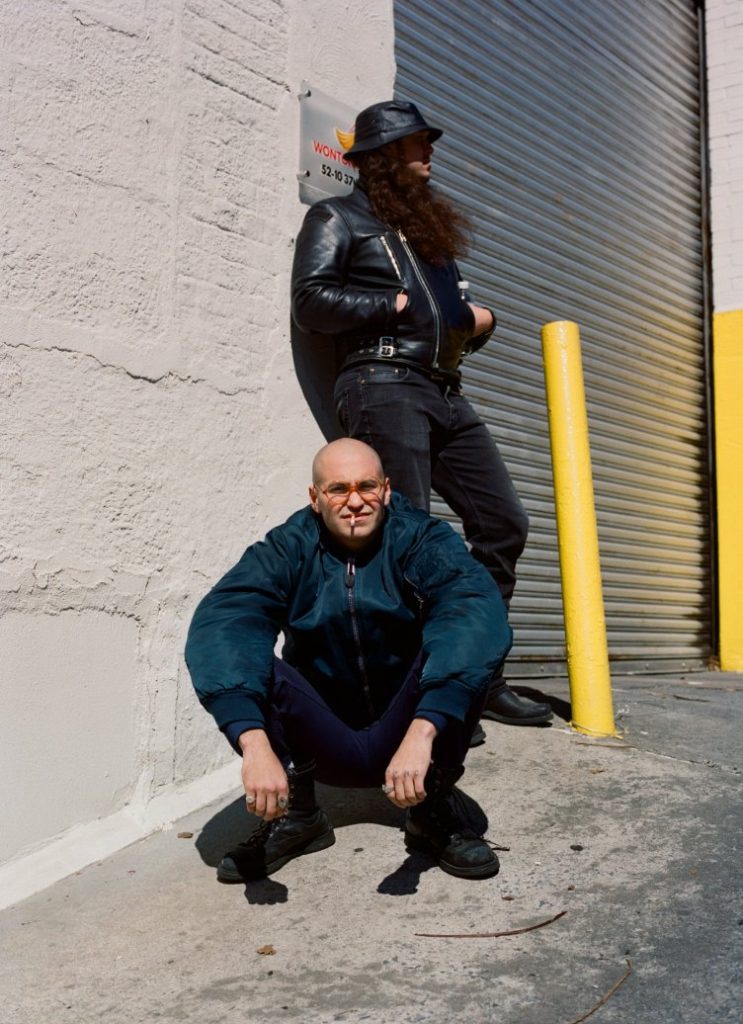


Show Me The Body is a New York City based ecClesiastical hardcore trio consisting of Julian Cashwan Pratt (founder; banjo and vocals), Harlan Steed (founder; bass), and Jackie McDermott (current drummer). The band has organized non-traditional, intentional DIY spaces for NYC youth since 2015, and since expanded that work to a global capacity through their urgent, ceremonial live shows, subterranean punk and hip-hop mixed tours, and their CORPUS NYC platform. Trouble the Water is the culmination of nearly a decade of barrelling against New York City’s structural ambivalence and indifference; an invocation to a like-minded global community to consider the alchemy of family-building, and of turning water to blood.
Trouble the Water both references and pays homage to the physical city, and the New York Sound: not one particular genre, but the people and subcultures that encapsulate it’s true foundation, style, and spirit; while expanding upon and reckoning with the hyperlocal territory of 2019’s Dog Whistle. With Pratt’s most encantatory, interrogative poetry to date, and Steed expanding the glitchy, caustic arena of his electronic experimentation, the band is feeling more like themselves than ever. The founding duo, who have worked together since 2009, used Trouble The Water to methodically inhabit one another’s forms; Pratt experimented recklessly with production and synths, while Steed challenged his own focus to include melodies and riffs.
Although the title invokes the ancient alchemy Moses wielded to free and unite Israelite peoples, Trouble The Water refuses nostalgia, or mimicry. Instead, it considers the sublime power of the unifying physical practices that can be enacted daily, to invoke immeasurable spiritual and collective reactions. Buoyed by moments of stinging stillness and compulsive, almost optimistic, malfunctioning rhythms, the work is literally a conjuration to dance, and move. If we are really living through the end of the world, maybe every movement we make, no matter how slight, is actually boundless and radical. How do we find freedom through rejecting time altogether, and existing only in communion, in space, and in the constellations we form as we choose our “blood” families? Or, as Pratt demands on Demeanor, “What’s better than when we come together? Fighting, dancing, fucking together.” Trouble the Water is at once a homily for those left behind or displaced, and a searing investigation of what survival looks like from within the borders of an aggressively policed city and state, that postures those unignorable calls for rage and migration to a world at war.
Bandmate and long-time music inspiration Jackie McDermott (Sediment Club, Urochromes), joined Show Me the Body in 2020 as drummer, and is featured on the project. Trouble The Water was recorded entirely at the band’s CORPUS Studios in Long Island City, with veteran metal producer Arthur Rizk, and co-engineered by studio co-founder Aidan Bradley.
Dog Whistle (2019) was produced by Chris Coady, Show Me The Body and Gabriel Millman. The heavy, honest project was in direct conversation with the oppressive, claustrophobic psychology of the city, and their most critically-acclaimed work to date, described by NME as “a dedication to the community, friends and family at the heart of Show Me The Body” coupled with “the jarring noise and harsh sonics that made [SMTB] one of punk’s most idiosyncratic voices.” Dog Whistle followed Show Me The Body’s now historic, genre-defying debut album Body War (2016).
Since 2015, Show Me the Body have expanded their international music community into an independent label, recording studio, and community organizing platform. The band recently completed their Half-A-USA tour with support from Soul Glo and WiFiGawd, which included their inaugural In Broad Daylight festivals in New York and Los Angeles. Through the intentional cultivation of their local and global chosen families, and a decade-long dedication to sustaining the New York Sound, Show Me the Body has solidified a legacy of confronting and permanently shifting the rigid limitations of the hardcore genre.
Provoker
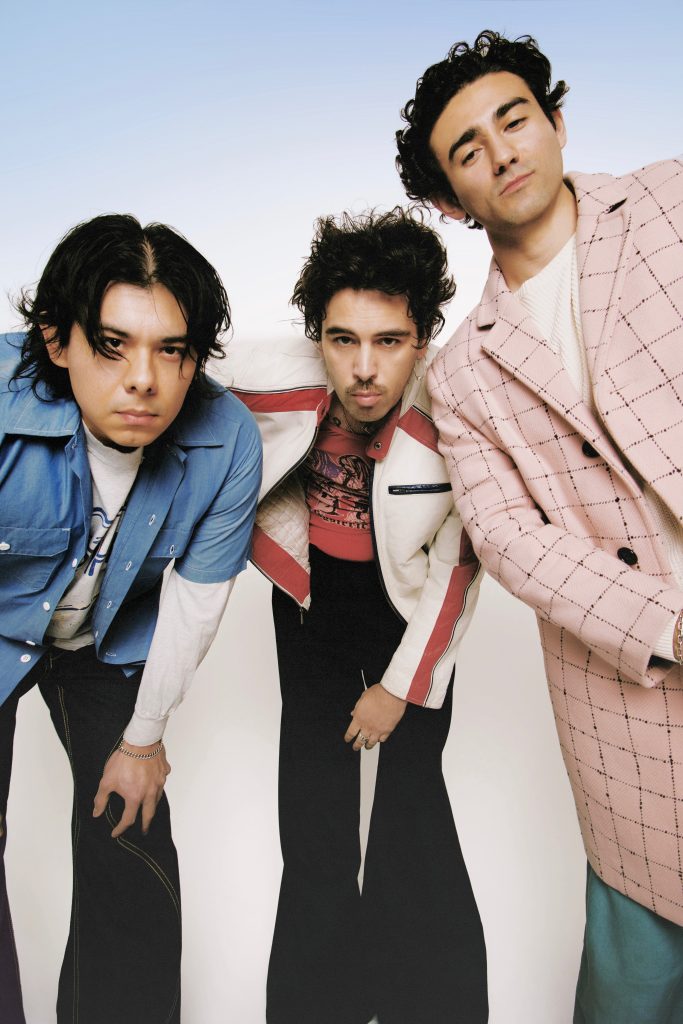
Provoker – Mausoleum By the time Provoker released their 2023 sophomore outing Demon Compass, they were already talking about their next album. The LA synth-pop trio were on a roll, and the songs kept coming. Holed up in an Echo Park attic, frontman Christian Crow Petty began to think of hauntings — him as a specter in his friends’ house, or the apparitions and memories that follow us around. Provoker’s next feat of world-building was underway, with Petty conjuring a landscape full of dead selves, the things we have left behind or dearly wish we could leave behind, all housed in a third album aptly titled Mausoleum. “It did make me feel like I was a ghost,” Petty laughs about his stint in the attic. “You’re the one making the creaks in the ceiling.” But as much as Mausoleum’s thematic content was defined by isolation, the music was the most communal of Provoker’s career. Petty deepened his songwriting partnership with Jonathon Lopez, the synth wizard who originally founded Provoker ten years ago as a solo vehicle to write imagined film scores. While some material was still completed individually, much of Mausoleum came together with Petty, Lopez, and bassist Wil Palacios workshopping ideas in various studio sessions, responding to each other in real time. Having promised new creative approaches for their third album, Provoker also opened themselves up to more collaboration. “Before, we were pretty reclusive,” Petty explains. Mausoleum found the trio working with a host of music scene friends, with production from Elliot Kozell, Simon Christensen, Mikey Heart, and Zach Fogerty — all of it overseen by none other than esteemed producer Kenny Beats. The burst of collaboration and inspiration meant Provoker had around twenty songs for Mausoleum. When they first met up with Kenny Beats, it was intended as a social hang, but after playing him a track he asked if he could rework it. This blossomed into an executive producer role where he took the nearly completed Mausoleum and put everything through a new filter, amping up the bass and drums across the album. “He made it sound like us, but way bigger,” Lopez recalls. With Beats’ guiding hand, Provoker achieved a new sense of grandeur. Their trademark aesthetic — synth shadows, crystalline beats, and smoky vocals equal parts R&B croon and post-punk growl, all influenced by otherworldly horror movies and video games — remains intact, but boasts a different scope and muscularity. Three albums in, Mausoleum finds Provoker at a moment of both synthesis and evolution, their unique sound having grown bolder and sharpened. Where in the past Petty filled Provoker’s music with supernatural creatures and sci-fi scenarios, he explores a subtler vein on Mausoleum — exorcising personal demons rather than fictitious ones, imagining the album taking place in a disgusting, squalid metropolis populated by ghosts sometimes literal but more often spiritual. It’s a distorted version of our own reality. “I like to make mini-movies, where if you listen to the song it places you in this world,” Petty explains. “This one is more of this world, but still haunting.” True to genre fiction that often spurs Petty’s writing, Mausoleum is shrouded in mystery. Petty conceived the album as an “anthology” with five storylines occurring at once, most of its tracks partnered in twos by themes of eternal human struggle — self-worth, relationships, redemption. “When you watch a movie, you see certain things happen to the character that are relatable,” Petty explains. “While made up, it’s something you’ve felt before.” “On the surface, the songs are stories,” Lopez adds. “You have to really listen to it to get those themes.” Mausoleum couches these emotions in Provoker’s characteristically vivid, lurid imagery. “Tears In The Club” may be something we’ve all felt — out at night seeking connection, but feeling like the odd one out — but it’s heightened, its protagonist depicted as a gross, creepy reveler on the dancefloor. Opener “Swarm Of Flies” derives from heartbreak, but relates the story of a man so riddled by loss he turns himself into a monster so he can never be loved again; similarly, the throbbing surge of “Gun 2 My Head” dramatizes relationship strife into a scene of a man infected by an apocalyptic disease begging his lover to kill him. At the same time, these songs are now balanced with some of Petty’s most vulnerable writing, with singles “Another Boy” and “Pantomime” wielding melancholic hooks and wistful synth lines to capture lovelorn existential crises. In the final act, the smeared, nocturnal atmospherics of Mausoleum’s title track captures the helplessness that connects so many of the album’s characters. Provoker marries the two approaches in “Replay.” A closer both shocking and poignant, it depicts a man whose wife dies, and he devotedly tends to her corpse in an attempt to keep their marriage alive when she herself is gone. “Replay it over and over again,” Petty sings in the chorus, the meaning of the words twisted in the song’s narrative, but sly in the context of the album. At its end, Provoker immediately invites you to return to the start and venture deeper and deeper into their world, to keep looking for the secrets buried deep in Mausoleum.
Dry Socket
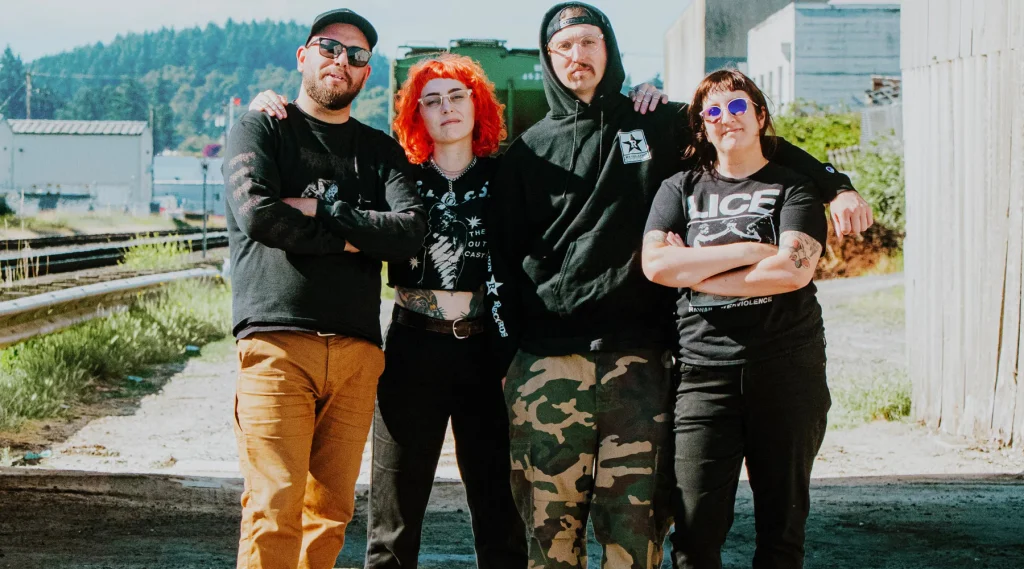
Dry Socket is a hardcore punk band from Portland, OR.
